![[personal profile]](https://www.dreamwidth.org/img/silk/identity/user.png)


Entry tags:
A Thousand Stars: Episode III, Part 16
After Obi-Wan's ship disappears in hyperspace, we have perhaps the most unique visual moment of the film. There is complete darkness, then this:

Which resolves briefly into a clearer image before fading into darkness again.


And similar strangeness for Padmé's image.


In the end, the vision slips away with this blurred moment that almost resembles hyperspace itself:

What does it all mean? Well, the obvious thing is that Anakin's still having visions of Padmé's death, and this one reveals that Obi-Wan is witnessing it. What it evokes, however, is much more fluid and open to interpretation. To me, it provides an altogether unsettling quality that highlights the turmoil of emotions; the horror and dread and helplessness. There is as well a sense of uncertainty -- is this a true future vision, or mere hallucination? Paranoia? Ultimately it will become a self-fulfilling prophecy of sorts, but Anakin doesn't know that. It has the awful quality of a vivid fever dream. No wonder it haunts him so much.
I'm also rather intrigued by the glimpse of experimental imagery that recalls Lucas's background as a film student on the cutting-edge of cinema techniques. Having watched a few of his dreamy, plot-light student films, I always wonder what sort of work he might have created if he'd ended up down a different path than the maker of "blockbusters" that he's become synonymous with. It was never his intent to churn out crowd-pleasing, predictable stuff. He liked the avant-garde, the evocative stuff that was more like poetry-via-cinema. In truth, I confess I might not have had as much enthusiasm for such less-accessible material. But I appreciate the idea of peculiar artistry.
Next time, a mirrored moment....

Which resolves briefly into a clearer image before fading into darkness again.


And similar strangeness for Padmé's image.
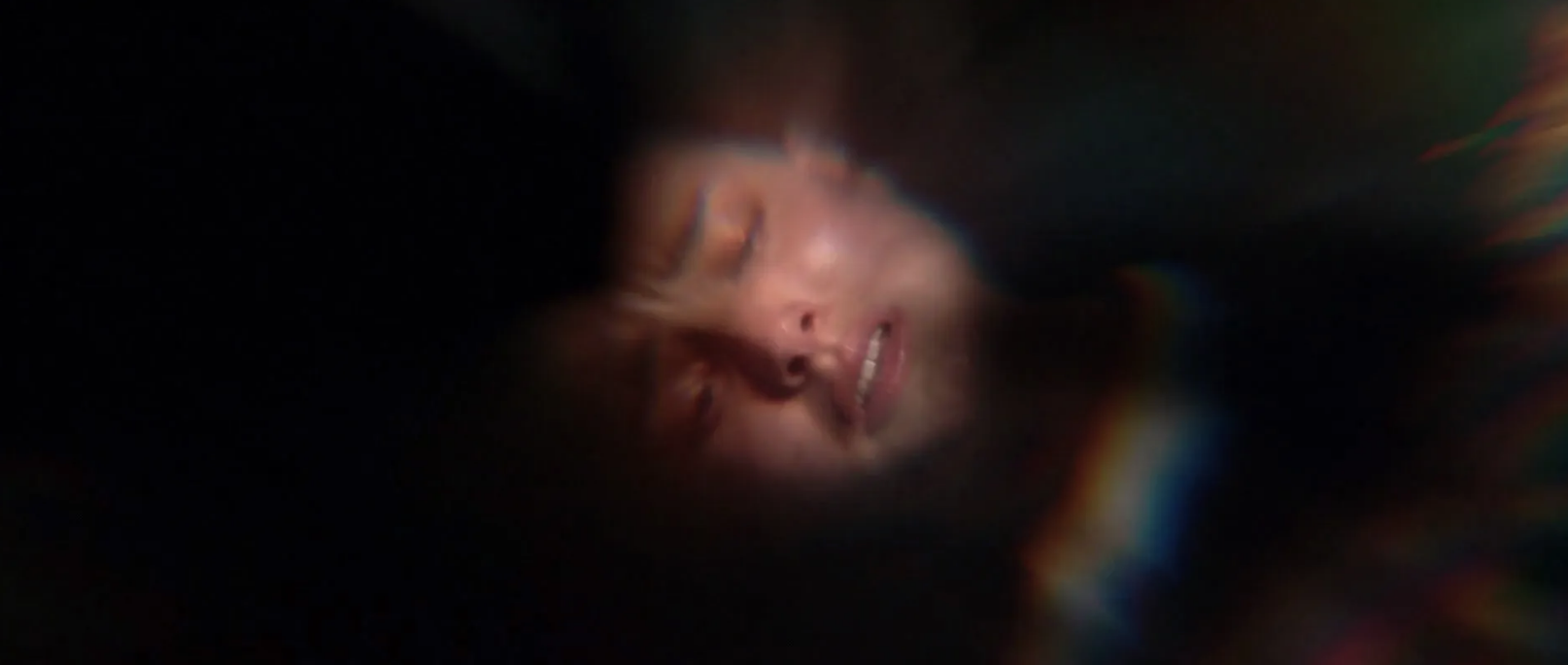

In the end, the vision slips away with this blurred moment that almost resembles hyperspace itself:

What does it all mean? Well, the obvious thing is that Anakin's still having visions of Padmé's death, and this one reveals that Obi-Wan is witnessing it. What it evokes, however, is much more fluid and open to interpretation. To me, it provides an altogether unsettling quality that highlights the turmoil of emotions; the horror and dread and helplessness. There is as well a sense of uncertainty -- is this a true future vision, or mere hallucination? Paranoia? Ultimately it will become a self-fulfilling prophecy of sorts, but Anakin doesn't know that. It has the awful quality of a vivid fever dream. No wonder it haunts him so much.
I'm also rather intrigued by the glimpse of experimental imagery that recalls Lucas's background as a film student on the cutting-edge of cinema techniques. Having watched a few of his dreamy, plot-light student films, I always wonder what sort of work he might have created if he'd ended up down a different path than the maker of "blockbusters" that he's become synonymous with. It was never his intent to churn out crowd-pleasing, predictable stuff. He liked the avant-garde, the evocative stuff that was more like poetry-via-cinema. In truth, I confess I might not have had as much enthusiasm for such less-accessible material. But I appreciate the idea of peculiar artistry.
Next time, a mirrored moment....